{ automotive spray booth }

  • Understanding the Benefits and Drawbacks of Different Automotive Spray Booth Types

    When you pick an automotive spray booth, you control paint quality. You also help keep workers safe and manage costs. Clean spaces in new booths stop dust and dirt. This makes paint jobs look nicer. Most auto body shops use downdraft booths for trucks. The airflow and exhaust work well in these booths. Semi-downdraft booths save money and are easy to set up. Crossdraft booths cost less but need more work for great finishes. If you buy high-end booths, you can make more cars and get perfect results.


    automotive spray booth


    Key Takeaways

    • Pick a crossdraft booth if you want to save money. It is simple to set up. It works for many jobs. You might need to clean more to stop dust.
    • Choose downdraft booths for better paint finishes. They give great results. They cost more to install. They are harder to set up.
    • Side-draft booths have balanced airflow and keep you safe. They give good paint jobs. They need more room. They cost more money.
    • Semi-downdraft booths mix features from both types. They help you save money. They fit in small spaces.
    • Think about your shop’s needs and budget first. Look at the kind of work you do. Good airflow and cleaning help you get the best results.


    Crossdraft Automotive Spray Booths

    Overview

    A crossdraft automotive spray booth has a simple airflow. Air comes in from the front of the booth. It goes through intake filters that catch dust and dirt. The air moves straight across the car or parts you paint. Then, it leaves through the back exhaust chamber. This chamber also has filters to trap paint overspray. The air always moves in one direction. This helps keep the booth clean inside. The exhaust filter is made with special glass fiber. This stops clogging and fogging. Clean air keeps flowing out of the booth.


    Main Advantages

    Crossdraft spray booths have many good points for your shop:

    • You can set up a crossdraft booth fast. You do not need a floor pit or a raised platform.
    • The price is lower than other paint booths. You save money when you buy and install it.
    • The booth is simple, so you pay less to run it. It does not need strong fans to move air.
    • The booth works quickly. It removes overspray and dirt fast. This helps you finish paint jobs sooner.
    • Crossdraft paint booths are good for many uses. Large paint booths like this can be used for painting cars, trucks, or large projects.
    • The airflow helps you get a smooth finish. You can give your customers great results.

    Tip: If you want to save money and still get good quality, a crossdraft booth is a smart pick.


    Large paint booths


    Key Drawbacks

    You should think about some problems before you pick a crossdraft booth:

    • The air moves sideways and can push dust onto the paint. This might hurt the finish.
    • You may need to work harder to keep the booth clean and control dust.
    • Crossdraft spray booths do not always meet the top safety rules for all jobs. Other booths can be safer.
    • The design is not best for shops that want perfect finishes or must follow strict safety codes.
    • If you want to save money and still get good work, crossdraft booths are a good choice. But you need to think about what your shop needs and how good you want your paint jobs to be.


    Downdraft Automotive Paint Booths

    Overview

    A downdraft automotive spray booth uses a special way to move air. Air comes in from the whole ceiling through filters.

    The air enters from the top and moves straight down. It goes over the car or truck and into the floor pit. The floor has grates, and air passes through them. The air then goes into an exhaust pit under the booth. This helps catch extra paint and keeps dust away. Downdraft booths use more than one filter. First, a pre-filter grabs big pieces of dirt. Next, a HEPA filter catches tiny dust and paint. The booth makes the air pressure lower inside. This keeps the air clean and the paint smooth.


    Main Advantages

    Downdraft paint booths give your shop many good things:

    • They control extra paint very well. Air moves down and takes away paint and dirt fast.
    • You get a great paint job. The booth removes dust right away. Your finish is smooth and even.
    • The air goes down and keeps your work area clean. You breathe better air, and fumes leave quickly.
    • You can use these booths for many jobs. They work for cars, trucks, and big projects.
    • Downdraft booths help you get great results. They keep your shop safe and clean.


    Key Drawbacks

    You should think about some problems before picking a downdraft booth:

    • It costs more to put in. You need a pit or basement for the exhaust.
    • The booth design is harder. You need special pipes and careful setup.
    • You must do regular checks. Filters need to be changed often to keep air moving well.
    • Downdraft booths cost more to install.
    • They are harder to build than other booths.
    • If you want the best paint and a clean shop, this booth is a good pick. You need to plan for the price and work, but the results are worth it.


    Side-draft Spray Booths

    Overview

    You will find that a side-draft spray booth uses a unique airflow system. Air enters from the ceiling and moves sideways across the booth. The air then exits through exhaust filters on the walls. This design helps remove overspray and keeps energy use low. Unlike other types, such as crossdraft booths, side-draft booths give you more uniform airflow. You get better control over dust and paint particles. This means you can expect a cleaner space and a higher-quality finish.


    Main Advantages

    Side-draft spray booths offer several important benefits for your shop:

    • You get even airflow from top to sides. This helps you avoid runs or streaks in your paint.
    • The booth keeps harmful fumes and vapors away from you. Clean air flows past your work area and out through the walls.
    • The filtration system traps toxic chemicals. You stay safer and meet safety rules.
    • You can achieve a smooth, professional finish. The booth reduces dust and keeps the paint job consistent.
    • These booths work well for both large and small parts. You can use them for many automotive paint booth projects.

    Note: A controlled painting environment helps you reach the best quality. You will see fewer defects and better results.


    Key Drawbacks

    You should know about some challenges with side-draft spray booths:

    • Height clearance can be a problem. If you work on large vehicles, you may not have enough space for proper coverage.
    • Not every automotive spray booth design fits all vehicles. Side-draft booths may not work well for trucks or buses with different shapes.
    • The cost to install a side-draft booth can be higher than basic models. You need to plan for this when choosing between booth types.
    • If you want a booth that balances safety, quality, and versatility, side-draft spray booths are a strong choice. Always match your booth to your shop’s needs for the best results.


    Semi-downdraft Automotive Spray Booths

    Overview

    You will find that a semi-downdraft automotive spray booth blends features from both crossdraft and downdraft types. Air enters from the ceiling and one end of the booth. It then moves downward and across the work area, finally exiting through the floor and the opposite end. This airflow design helps remove overspray and fumes from your workspace. You get a balance between the strong downward air of a downdraft booth and the simple setup of a crossdraft booth. Many shops choose this style for medium-sized operations because it offers flexibility and good quality.


    Main Advantages

    You can enjoy several benefits when you pick a semi-downdraft automotive paint booth:

    • You save on cost since you do not need a deep pit for the exhaust system.
    • You can install this booth in places where a full downdraft booth will not fit, giving you more options for your shop layout.
    • You get flexibility to upgrade later, such as adding heated makeup air, without major changes.
    • The airflow helps keep your work area cleaner than a basic crossdraft booth.
    • Many spray booths of this type work well for both cars and trucks, making them a smart choice for growing shops.

    Tip: If you want a booth that balances installation cost, safety, and finish quality, a semi-downdraft booth gives you strong value.


    Key Drawbacks

    You should know about some challenges with semi-downdraft spray booths:

    The only downside of semi-downdraft paint booths is the potential for dead airflow spots at the front of the spray booth, along the floor. Dead spots, or areas where air does not flow properly over the product, can make spraying difficult even for the most skilled painter.

    You may notice that these dead spots can affect the quality of your paint job. You might need to adjust your painting technique or booth setup to avoid uneven finishes. If you want the highest quality for every job, you should consider how airflow patterns in different spray booths can impact your results.


    Comparing Automotive Spray Booth Types

    Key Differences

    When you look at spray booths, you see big differences. Each booth costs a different amount. Some are easy to set up, while others are harder. Air moves in different ways in each booth. The finish quality also changes with each type. Every booth works best for certain jobs in car and truck shops. You should check these things before you pick a booth for your shop.

    Here is a table that shows the main features of each booth type:

    Type of Booth

    Airflow Pattern

    Advantages

    Disadvantages

    Crossdraft

    Air drawn from front to rear

    Cost-effective, easy to install

    May not provide best air quality

    Semi-downdraft

    Mix of crossdraft and downdraft

    Improved airflow and paint quality

    More expensive than crossdraft booths

    Downdraft

    Air drawn from ceiling to floor

    Superior finish quality

    Higher cost, complex installation

    Side-downdraft

    Air pulled from sides to floor

    Balanced airflow and quality

    Requires more space and investment

    You can also see how finish quality compares across booth types:

    Booth Type

    Advantages

    Limitations

    Crossdraft

    Economical, simple design, good for standard jobs

    Limited contamination control, lower finish quality

    Semi-downdraft

    Better overspray control, good balance of cost/quality

    Not as effective for high-end applications

    Side-downdraft

    Uniform airflow, higher quality finishes

    Higher cost, not for all applications

    Downdraft

    Best airflow control, ideal for premium finishes

    High initial and operational costs

    You should also think about how much each booth costs. The chart below shows how prices change with booth size and type:
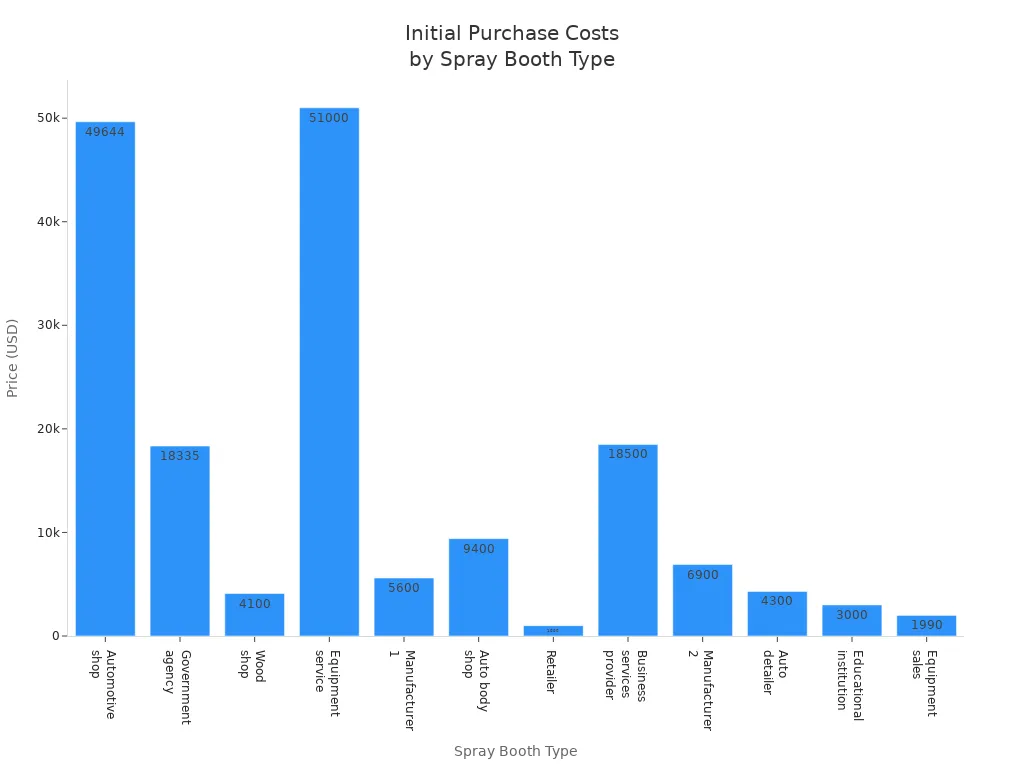
    Bar chart comparing initial purchase costs for different automotive spray booth types.

    Downdraft booths use more energy because air moves from the top to the bottom. Side-downdraft booths use less energy and have good airflow. Crossdraft booths save money but may not save as much energy as downdraft booths.

    You need to keep every booth clean. Clean your booth every day. Change filters often. Check the airflow to make sure it works right. Good filters and fans help stop dust and keep your shop safe.

    NFPA and OSHA rules apply to all spray booths. Fully closed booths help you follow these rules and keep out dust. Always check your local rules before you buy a booth.


    Choosing the Right Booth

    Pick a booth that fits your shop’s needs. Here are some steps to help you choose:

    • Think about what you will paint. If you work on cars or trucks, you may need a big booth.
    • Look at your space. Make sure you have enough room for the booth and to work safely.
    • Set your budget. Crossdraft booths cost less, but downdraft and side-downdraft booths give better finishes.
    • Decide what finish you want. If you want a great paint job, pick a downdraft or side-downdraft booth.
    • Think about energy and running costs. Downdraft booths use more energy but give the best results.
    • Talk to a professional spray booth manufacturer. They can help you find the right booth and make sure you follow safety rules.

    Tip: If your shop is small, a crossdraft booth is cheap and easy to put in. If you want the best results and have more money, pick a downdraft or side-downdraft booth.

    Remember to keep your booth clean. Change filters often to keep it safe and working well. Good filters and fans protect your workers and your paint jobs.

    Some shops forget to think about airflow or dust problems. Always pick a booth that fits your space, money, and quality needs. This helps you do the best work for your customers and your shop.


    You can look at the table to find the main good and bad points for each spray booth type:

    Booth Type

    Pros

    Cons

    Crossdraft

    Low price, simple to set up

    More chance for dust

    Downdraft

    Best paint job, less dust

    Costs more, harder to install

    Side-draft

    Air moves evenly, filters work well

    Needs bigger space, costs more

    Semi-downdraft

    Good price and paint quality

    Air might not move everywhere

    Pick a booth that fits your shop’s size, money, and what you need to do. Good filters and airflow help stop mistakes and keep workers safe. Think about how your choice will help your shop work better for a long time.

  • Visit us at Automechanika Shanghai 2025, Booth No 6.2F38

    Guangli is excited to announce our participation in Automechanika Shanghai 2025, happening from November 26 to 29, 2025, at the National Exhibition and Convention Center (Shanghai). As one of the leading automotive spray booth manufacturers, we invite all visitors, partners, and distributors to visit us at Booth No. 6.2F38 to explore our latest spray booth and 3D man lift innovations.


    Booth No.: 6.2F38

    Date: Nov. 26 – 29, 2025

    Add: 333 Songze Avenue, Qingpu District, Shanghai, China.

    Email: sunnie@gzguangli.com.cn

    ☎Call: +86 13925061383

    Official website: https://www.gzguangli.com/


    What We Will Showcase

    As a leading automotive paint spray booth manufacturer in China, Guangli is dedicated to delivering the latest Chinese paint booth solutions that help our customers grow their business. Let’s take a quick look at what we will showcase at Automechanika Shanghai:

  • How Much Does a Paint Booth Cost

    If you want to know how much a paint booth costs, prices can range widely based on type and size. For example, a portable paint booth (10x10) often costs about $4,495. Custom paint booths can vary depending on your needs.

    Type of Paint Booth Price Range
    Portable (10x10) $4,495.00
    Custom Varies

    The cost changes based on booth size, ventilation, materials, and extra features. You should look at every cost factor before you decide to buy.


    Key Takeaways

    • Paint booth prices change a lot depending on size, type, and features. Portable booths cost about $2,000. Big custom booths can cost more than $40,000.
    • Think about the booth size before buying. Bigger booths have better airflow and work faster. But bigger booths also cost more money.
    • Some booths have special features like good filters, heating, and safety gear. These features can make the booth cost more. Pick features that help keep you safe and work better. Try not to spend too much.
    • It costs money to install and take care of the booth. Make sure you plan for these costs. This helps you avoid problems and keeps your booth working well.
    • Always check your local rules for permits before you set up the booth. Following the rules helps you avoid fines. It also keeps your work area safe.


    auto spray paint booth


    Paint Booth Price Overview


    When you look for a paint booth, you will see prices are very different. The price changes because of the size, type, and features you want. Here is a simple list of the most common paint booths and what you might pay.


    Portable Paint Booths

    Portable paint booths are easy to move and set up. You can put them where you need them. Most portable booths have inflatable walls or light frames. They usually cost between $2,000 and $12,000. The price depends on the size and features.

    Tip: Portable booths often have EPA-compliant ventilation, exhaust filters, and air movers. These things help keep your work area safe and clean.

    Size/Type Price Range Key Features
    Small (10x10) $2,000 - $5,000 Cheap, easy to set up, good for hobbies
    Medium (12x12x9) $5,000 - $7,000 Small, good for little jobs
    Large (18x15x10 or 24x15x10) $9,000 - $12,000 Big, for pros, better air flow

    You can also buy simple tent-style booths for less than $100. These do not have air filters and may not be safe.


    Small Paint Booths

    Small paint booths are good for small spaces or little projects. You might use one to paint car parts or small tools. Prices start at about $3,000 and go up to $8,000. The price depends on how big the booth is, what it is made of, and the airflow system.

    • Bigger booths cost more money.
    • The way the booth moves air, like downdraft or crossdraft, changes the price.
    • Better filters or safety features make the booth cost more.
    Factor Impact on Price
    Size Bigger booths cost more
    Configuration Downdraft costs more than crossdraft
    Materials Stainless steel costs more than regular steel
    Filtration Multi-stage HEPA systems make the price go up
    Compliance Meeting safety rules adds to the price


    Medium Paint Booths

    Medium paint booths are used in most auto shops and small businesses. You will pay between $8,000 and $15,000 for a medium booth. These booths have more space and better air flow than small booths.

    • Medium booths often have better air and lights.
    • Some have heaters to dry paint faster.
    • Following environmental rules can make the price higher.

    Pick a medium booth if you need to paint whole cars or big parts often.


    Large Paint Booths

    Large paint booths are for big jobs, like trucks, trailers, or big machines. Prices are usually between $19,000 and $40,000. These booths are used in places like airplane factories, heavy equipment shops, and RV makers.

    • Bigger booths need more materials and cost more to install.
    • Fancy air systems, like downdraft, make the booth better but cost more.
    • Heaters, filters, and safety gear can add 10-20% to the price.

    Note: If you add more features, like machines or special lights, the price will go up.


    Custom Paint Booths

    Custom paint booths are made just for you. You might want a special size, different air flow, or extra safety. Custom booths start at $20,000 and can go over $40,000 for big or fancy ones.

    Custom Booth Type Price Range
    Basic Open Front Booth Starting at $2,599
    Enclosed Finishing Booth $4,599 - $10,000+
    Large Booth for Heavy Equipment $20,000 - $40,000

    The final price depends on:

    • Airflow system type
    • Heating and air features
    • Safety gear
    • Automation and control systems

    Custom booths fit your work best, but you pay more for special design and building.

    When you look at paint booth prices, think about what features you really need. The right booth will help you stay safe and work well.


    Paint Booth Cost Factors

    Size

    You need to think about size first. The size of a paint booth changes how much you pay and how you use it. If you choose a smaller booth, you spend less money and save on running costs. However, a booth that is too small can make your work harder. You might see more dust and poor airflow. This can ruin your paint job. Bigger booths cost more because they use more materials and need extra features. The right size helps you work faster and keeps your paint clean.

    • Smaller booths lower costs but may reduce efficiency.
    • Larger booths require more money and offer better airflow.
    • Proper sizing keeps your work safe and high-quality.


    Type

    The type of paint booth affects the price and how you paint. You can pick from many types. Each one has its own features and costs.

    Paint Booth Type Description Cost Range
    Crossdraft Simple design, cost-effective, but overspray can be a problem. Lower
    Downdraft Great airflow, high-quality finishes, higher price. Higher
    Side Downdraft Good for small spaces, better control. Medium
    Semi-Downdraft Mix of crossdraft and downdraft, improved airflow. Medium
    Reverse Flow Air enters from the floor, special uses. Higher
    Open-Face Easy access, less containment, lower price. Lower
    Enclosed Controlled environment, best containment, higher price. Higher
    Conveyorized For big jobs, automated, highest price. Highest

    You should pick the type that fits your work and budget.


    Features

    Features can make your paint booth cost more. You can add things like heaters, special lights, or air makeup units. These extras help you paint better and safer. For example, lighting and safety gear can add 10-20% to the total price. If you want a booth with heating and advanced airflow, you pay much more. Think about which features you need most.

    Tip: Choose features that help you work safely and quickly. Do not pay for extras you will not use.


    Build Quality

    Build quality matters for long-term savings. A strong booth wastes less paint and keeps your work area clean. High-quality booths last longer and need fewer repairs. You get more value because you spend less on materials and downtime.

    • Good build quality lowers waste and saves money.
    • Reliable booths keep your work moving.
    • Code-compliant booths prevent extra costs and delays.

    If you pick a paint booth with strong build quality, you protect your investment and make your work easier.


    Installation & Operating Costs

    Installation Fees

    You need to plan for installation costs when you buy a paint booth. These fees depend on the size and type of booth you choose. Small open face booths cost less to install. Large enclosed or downdraft booths cost much more. Here is a table that shows average installation fees for different booth types and sizes:

    Booth Type Dimensions (W x H x D) Average Cost
    Open Face Booth 6' x 7' x 6' $2,700
    Open Face Booth 10' x 12' x 6' About $5,000
    Open Face Booth 18' x 7' x 6' $5,871
    Enclosed Truck Booth 14' x 10' x 24' About $12,500
    Enclosed Truck Booth 20' x 16' x 34' About $29,000
    Down Draft Booth 14' x 10' x 24' About $16,000
    Down Draft Booth 20' x 16' x 30' About $35,000
    Automotive Paint Booth (Basic) 14' x 9' x 27' About $14,000
    Automotive Paint Booth (Cured) 14' x 9' x 27' $50,000 - $65,000

    You may also pay extra for pressurized booths. Air makeup units can add $15,000 to $22,000 to your total cost.


    Permits & Compliance

    You must get the right permits before you install your booth. These permits help keep your shop safe and legal. Costs can range from a few hundred dollars for simple permits to several thousand dollars for full inspections. Here are some common permits you may need:

    • Building permits for safety and zoning
    • Fire department permits for flammable materials
    • Environmental permits for air quality
    • Occupational safety permits for worker protection
    Type of Permit Cost Range
    Simple Permits A few hundred dollars
    Extensive Inspections Several thousand dollars

    Tip: Always check with your local city or county office before you start your project.


    Energy & Maintenance

    You will spend money to run and maintain your booth. Energy costs depend on the size of your booth and how often you use it. Large booths with heaters or advanced airflow use more electricity. You need to change filters and clean the booth often. Regular maintenance keeps your booth safe and working well. If you skip maintenance, you may pay more for repairs later.

    Keeping up with energy and maintenance costs helps you avoid big problems and keeps your work on track.


    Additional Paint Booth Expenses

    When you buy a paint booth, you need to plan for extra costs beyond the booth itself. These hidden or ongoing expenses can affect your budget. You should know about shipping, accessories, and repairs before you make your final decision.


    Shipping

    Shipping costs can change based on where you live and the size of your booth. Some companies offer free shipping in the contiguous United States, but most booths require freight shipping. You may see prices quoted at the time of your order. Freight charges can go up or down quickly, so you cannot always predict the final cost.

    • Shipping costs vary and depend on booth size and location.
    • Some products include free shipping, but most do not.
    • Freight charges change often and may not stay the same for long.

    Tip: Ask for a shipping quote before you buy your automotive spray booth or truck paint booth. This helps you avoid surprises.


    Accessories

    Accessories help you get the most from your car spray booth. You can choose from many add-ons that improve safety, speed, and quality.

    • Advanced LED lighting systems make it easier to see your work.
    • High-efficiency filter systems keep the air clean.
    • Accelerated curing systems, like infrared or UV, dry paint faster.
    • Air makeup units and ventilation systems control airflow.
    • Heating and temperature control systems keep paint at the right temperature.
    • Masking tools and systems save time.
    • Vehicle and parts positioning systems help you reach every spot.
    • Technician access platforms, like scaffolds, keep workers safe.
    • Automated paint gun cleaning systems make cleanup easy.
    • Booth cleaning tools help you keep your booth spotless.

    Note: Accessories can add hundreds or thousands of dollars to your total cost. Plan for these extras when you set your budget.


    Repairs

    You need to keep your paint booth in good shape. Routine maintenance includes cleaning, inspections, and replacing small parts. If you use high-quality booths, like those from brands such as gzguangli, you may see fewer breakdowns and lower repair costs.

    1. Replace filters on time to protect paint finishes.
    2. Keep up with maintenance to keep workers safe.
    3. Follow rules to avoid fines and extra costs.

    Understanding when to change filters and parts helps you control costs and keep your booth running well. Regular care keeps your production smooth and your booth safe.

    Budgeting Tip: Set aside money for repairs and maintenance. This helps you avoid big bills and keeps your booth working for years.


    Paint Booth Budgeting & Selection

    Assessing Needs

    You should start by understanding what you need from a paint booth. Think about the size of your operation and how much energy you will use. Here are some steps to help you:

    1. Check your energy needs based on how many jobs you do.
    2. Work with an electrician to see if you can install the booth safely.
    3. Learn about local rules for power and waste.
    4. Make sure you have at least 3 feet of space around the booth for safety.
    5. Ask experts for help if you need a custom design.
    6. Pick a booth that fits your work, like an automotive spray booth, truck paint booth, or car spray booth.

    You should always make sure your booth meets your daily work needs and follows safety rules.


    Comparing Quotes

    You will get different prices from different companies. Look at what each quote includes. Some booths, like those from gzguangli, offer strong build quality and good support. Compare the features, installation costs, and warranty. Do not just pick the cheapest option. Make sure the booth fits your space and your work.

    • Check if the quote includes shipping and installation.
    • See if the booth meets all safety and code rules.
    • Ask about support and repairs.


    Planning Ahead

    Planning helps you avoid surprise costs. You should keep your booth in good shape. Use this table to see how regular care helps:

    Maintenance Practice Benefit
    Regular filter replacement Prevents airflow problems and keeps paint quality high
    Scheduled exhaust system maintenance Reduces breakdowns and keeps things running smoothly
    Cleaning spray guns Stops sudden failures and keeps your work looking good

    You should also look for ways to make your work faster. Try to find and fix slow spots in your process. Use fast-drying paints and keep your tools ready. Always have a backup plan for repairs and emergencies.


    Avoiding Pitfalls

    Many people make mistakes when buying a paint booth. Here are some things to watch out for:

    • Do not forget about energy costs. These can be high.
    • Make sure you get all the upgrades you need for safety.
    • Always use a pro for installation to follow safety rules.

    Careful planning and smart choices help you get the right booth for your shop and save money in the long run.


    You can buy a small open face booth for $2,700. A big automotive spray booth can cost over $65,000. The main costs are the booth, air make up units, ductwork, installation, and maintenance.

    Cost Factor Why It Matters
    Purchase Price Upfront investment
    Installation Setup and utility work
    Maintenance Keeps your booth safe and efficient
    Operating Costs Energy and filter replacement

    You should think about all the costs, not just the price tag. Use the tips in this guide to pick a car spray booth, truck paint booth, or a gzguangli model that works for your needs and budget.


    FAQ

    How often should you replace filters in a paint booth?

    You should check filters every week. Replace them when they look dirty or clogged. Clean filters help your automotive spray booth or truck paint booth work better and keep the air safe.

    Can you use a car spray booth for trucks?

    A car spray booth is usually too small for trucks. You need a truck paint booth for bigger vehicles. Always measure your vehicle before you buy a booth.

    What makes gzguangli paint booths different?

    Gzguangli paint booths use strong materials and smart airflow systems. You get better safety and cleaner paint jobs. Many shops trust gzguangli for both car and truck painting.

    Do you need a permit to install a paint booth?

    Yes, you need permits for most paint booths. Check with your local city or county office. Permits help you follow safety and environmental rules.

    How can you lower energy costs in your paint booth?

    Use LED lights and change filters often. Keep doors closed when you paint. Good habits help you save money in your automotive spray booth or truck paint booth.


  • Step-by-Step Guide to Installing an Automotive Spray Booth

    You might ask, "How can I set up an automotive spray booth?" Setting up your own booth lets you be in charge. It also helps you spend less money. Many booths are made for people to install themselves. Smaller open-front models are easier to put together. You can save $4,000 to $8,000 if you do it yourself. Suppliers and online videos give you help and advice. You learn new skills and feel more confident as you work.


    Key Takeaways

    • Building your own automotive spray booth can save you a lot of money. You will also learn important skills.
    • Pick a safe place with good airflow. Check local permits and safety rules before you begin.
    • Collect all the tools you need. Carefully check your parts with the inventory list so you do not get delayed.
    • Use TEK screws to put it together fast and strong. Use nuts and bolts if you want to move your booth later.
    • Always follow safety rules. Set up good ventilation. Do regular maintenance to keep your booth safe and working well.


    Why Install an Automotive Spray Booth Yourself

    Automotive Spray Booth

    Save on Installation Costs

    You can save a lot of money by installing your own automotive spray booth. Many people do not realize how much professional installation costs. When you choose the DIY route, you keep more money in your pocket.

    Savings range from $4,000 to $8,000.

    This amount can be more than half the cost of the booth itself.

    You can use the extra money for tools, paint, or upgrades.

    Tip: Always check the price of installation before you buy a booth. You may find that doing it yourself is the best option.


    DIY vs. Professional Help

    You have two main choices for setting up your booth. You can do it yourself or hire a professional.

    DIY auto painting saves you money compared to professional jobs.

    Professional installers use special equipment and have more experience.

    They often achieve higher quality results, especially with advanced HVLP sprayers.

    DIY projects let you learn new skills and gain confidence.

    If you want a perfect finish, you may need to practice or ask for help. Many people start with simple booths like an auto spray booth or an auto body spray booth. These models are easier to assemble and use.


    Support and Tutorials Available

    You do not have to work alone. Many spray booth manufacturers offer support and tutorials.

    You can find step-by-step videos online.

    Suppliers answer questions and help with problems.

    Manuals and guides make the process clear.

    Note: If you run into trouble, reach out to the supplier or check online forums. Many truck paint booth owners share tips and advice.

    Installing your own booth gives you control and saves money. You can build skills and get support when you need it.


    Preparation and Planning


    Choose the Right Location

    Pick a place that fits your automotive spray booth. The surface should be flat and have enough space. You need room to move around the booth. Make sure there is power nearby. Good ventilation is important for safety. If you use a garage or workshop, check the ceiling height. Think about how close the booth is to doors and exits. Look at local building codes before you start. Many cities want you to get permits and safety checks. Some places need fire suppression systems and air quality controls. These rules help keep you safe and protect the environment.

    Tip: Talk to your local authorities about permits and safety rules before you begin. This step helps you avoid delays and problems later.


    Gather Tools and Materials

    You need the right tools to build your booth. Most kits from a spray booth manufacturer have basic parts. You may need extra items for your project. Common tools are a drill, screwdriver, wrench, measuring tape, and safety gear. You should wear gloves, goggles, and a dust mask. If you use an auto body spray booth or a truck paint booth, check the instructions for special tools. Make a list of everything you need before you start. This step saves time and keeps your project on track.

    Tool

    Purpose

    Drill

    Fasten panels

    Screwdriver

    Secure screws

    Wrench

    Tighten bolts

    Measuring Tape

    Check dimensions

    Safety Gear

    Protect yourself


    Review Safety Guidelines

    You must follow safety rules when you install an automotive spray booth. Industry standards help keep you safe and protect your workspace.

    Use proper ventilation and exhaust filters to protect air quality.

    Lower fire risks by using spark-arrestor systems and storing flammable materials safely.

    Follow all safety codes from groups like EPA and OSHA. Make sure your booth uses strong materials and has a good exhaust system.

    Make safe storage and mixing rules for flammable liquids. Always wear protective equipment.

    Note: Safety is the most important part of your project. Take time to read the manual and follow every guideline.


    Unpacking and Checking Parts


    Inventory Checklist

    Check every part before you start building your booth. Open each box and put the parts out. Use the inventory checklist from your spray booth manufacturer. Gzguangli gives detailed lists for their truck paint booth and auto body spray booth kits. Mark each item as you find it. If you miss a part, your project could be delayed. Double-check everything to make sure nothing is missing.

    Item

    Check (✔/✘)

    Panels and doors


    Intake plenum


    Exhaust chamber


    Air make-up unit


    Manometer


    Lighting


    Control panel


    Fire suppression


    Tip: If you see any damaged or missing parts, contact your supplier right away. Most companies will send new parts quickly.


    Identify Main Components

    You need to know the main parts before you start building. This helps you see how everything fits together. Gzguangli makes their auto spray booth kits with clear labels and instructions. Look for these important parts:

    Paint booth walls and doors

    Air intake plenum

    Exhaust chamber

    Air make-up unit (AMU)

    Manometer

    Working chamber (work area)

    Exhaust filtration

    Starter/control panel

    Fire suppression system

    Lighting

    Airflow management

    Grounding

    These parts help keep your booth safe and working well. Each one helps keep the air clean, control fumes, and protect you while painting.


    Read Manufacturer Instructions

    Read the instructions from your spray booth manufacturer before you begin. Gzguangli gives step-by-step guides for their truck paint booth and auto body spray booth models. The manual tells you how to build, ventilate, and wire the booth. If you skip this step, you could get hurt by particles in the air or fumes. The instructions also show you how to take care of your booth. Change filters, clean overspray, and check for leaks often. A well-built automotive spray booth keeps you safe and helps paint dry faster.

    Note: Always follow the manual. It keeps you safe and makes sure your booth works right.


    Assembly Methods for Spray Booths


    TEK Screws vs. Nuts and Bolts

    When you build an automotive spray booth, you must choose how to connect the panels and frame. Most kits from a spray booth manufacturer use TEK screws or nuts and bolts. TEK screws work well for auto spray booth and truck paint booth projects. You drive TEK screws directly into metal. You do not need to drill pilot holes. Nuts and bolts require you to align holes and tighten each connection. Many auto body spray booth kits include both options.

    Here is a simple table that shows the differences:

    Feature

    TEK Screws

    Nuts and Bolts

    Assembly Time

    Takes half as long to install

    Time-consuming due to alignment

    Durability

    Designed for long-term use, do not loosen

    Can loosen over time, causing misalignment

    TEK screws help you finish your booth faster. Nuts and bolts take more time because you must line up each hole and secure every bolt.


    Pros and Cons

    You need to know the strengths and weaknesses of each method. TEK screws make the job easier. You save time and effort. They stay tight and do not loosen. You can trust your auto spray booth to stay strong. Nuts and bolts give you a solid connection. You can take them apart if you need to move your booth. Over time, nuts and bolts may loosen. This can cause panels to shift or misalign.

    Pros of TEK Screws:

    Quick installation 

    No need for extra tools

    Stays tight for years

    Cons of TEK Screws:

    Harder to remove if you want to change your booth

    Not as flexible for adjustments

    Pros of Nuts and Bolts:

    Easy to take apart and move

    Strong connection for heavy panels

    Cons of Nuts and Bolts:

    Slower to install


    Can loosen and need retightening

    Tip: If you want to build your automotive spray booth quickly and keep it strong, TEK screws are a smart choice. If you plan to move your booth or change its layout, nuts and bolts may suit you better.


    Automotive Spray Booth Installation Steps


    Site Preparation

    Start by preparing your site before you build your automotive spray booth. You need to make sure the area is safe and ready for installation.

    Clear the ground of debris, plants, and standing water.

    Pick a level spot for your booth.

    For permanent booths, pour a reinforced concrete slab at least 4 inches thick.

    Make sure the floor has a slight slope (1–2%) to help water drain away.

    Install drainage channels if water collects in the area.

    Check your local building codes and permit rules. Some places require fire suppression systems or special ventilation. Always ask your local authorities about these rules before you begin. This step helps you avoid problems later.

    Tip: Fire safety is important. Make sure your site meets all fire safety requirements before you start building.


    Frame Assembly

    Once your site is ready, you can start assembling the frame. Lay out all the frame parts from your spray booth manufacturer. Use your instruction manual to match each piece.

    Begin with the base frame.

    Attach the vertical supports.

    Secure the top frame to complete the structure.

    Use TEK screws or nuts and bolts, depending on your kit. Make sure each connection is tight. Check that the frame stands straight and level. If you build a large truck paint booth or auto body spray booth, you may need help to lift heavy parts.

    Note: Watch video tutorials or contact your supplier if you have questions about frame assembly.


    Panel and Door Installation

    Next, install the panels and doors. Start with the wall panels.

    Attach each panel to the frame, making sure they fit snugly.

    Use the fasteners provided by your spray booth manufacturer.

    Install the doors last, checking that they open and close smoothly.

    Seal all joints to prevent air leaks. Good sealing keeps dust and fumes out of your work area. If you use an auto spray booth, check the manual for special door hardware or seals.


    Ventilation and Filtration Setup

    Proper ventilation and filtration keep you safe while you work.

    Install the intake and exhaust systems as described in your manual.

    Use high-efficiency particulate air (HEPA) filters for best results.

    Set up a dual-filter system with a pre-filter for large particles and a final filter for fine dust.

    Industrial booths need strong fans. Look for fans with a CFM (cubic feet per minute) rating between 10,000 and 20,000 for good airflow.

    Place the fans and ducts according to your booth’s design (downdraft, side-draft, or re-circulating).

    Make sure the airflow speed at the booth face is between 100 and 150 feet per minute.

    Some booths have heating systems to keep the temperature between 70°F and 80°F. This helps paint cure faster and gives a better finish.

    Tip: Always check that your ventilation system removes fumes and dust from the booth. Clean or replace filters often.


    Electrical and Lighting

    Safe electrical work is key in any automotive spray booth.

    Ground the booth to prevent electrical hazards.

    Use only electrical equipment made for flammable environments.

    Here is a table of important electrical and lighting requirements:

    Requirement

    Description

    Grounding

    Ground the booth to prevent electrical hazards.

    Equipment

    Use equipment designed for flammable environments.

    Class I, Division 1

    All equipment inside the booth must be rated for hazardous locations.

    Class I, Division 2

    Equipment within 3 feet of booth openings must meet this safety rating.

    Enclosed Lamps

    Lamps within 20 feet of spraying must be totally enclosed.

    Protection

    Lamps must have guards or be placed to avoid damage.

    Install all wiring and lighting according to your manual and local codes. Use enclosed lamps to prevent sparks. Protect all lights with guards or covers.


    Final Safety Check

    After you finish building your booth, perform a full safety check.

    Test the ventilation to make sure it removes fumes.

    Check that all equipment is explosion-proof and safe for flammable materials.

    Make sure fire suppression systems work and are easy to reach.

    Store all flammable liquids in safe containers, away from heat or sparks.

    Wear personal protective equipment (PPE) like gloves, goggles, and masks.

    Inspect your booth for leaks, loose panels, or damaged parts. Clean the booth to remove dust and paint buildup. Plan regular maintenance and inspections to keep your booth safe and working well.

    Note: Always follow OSHA and local safety standards. Regular checks help prevent accidents and keep your booth in top shape.

    If you get stuck or have questions, watch video tutorials or contact your spray booth manufacturer for support. Many auto spray booth and truck paint booth owners share tips online, so you can learn from their experience.


    Troubleshooting and Tips


    Missing or Damaged Parts

    Sometimes, parts are missing or damaged when you open your auto spray booth kit. Check the inventory list from the spray booth manufacturer before you start building. If you see any problems, contact the supplier right away. Most companies send new parts fast. Keep all packaging and labels until your auto body spray booth is finished. This helps you keep track of parts and makes returns easier.

    Some people make mistakes by moving the booth without the right equipment. Others try to save money by skipping steps. These choices can cause accidents or make the booth work poorly. Always use the correct tools and follow the instructions from your spray booth manufacturer.


    Alignment and Sealing Issues

    Good alignment and sealing are important for safety and performance. If you do not seal your automotive spray booth well, toxic fumes can leak out. This can make you feel sick or have trouble breathing. Build your booth by OSHA safety standards to stay safe.

    Fireproofing is a key step in building a DIY paint booth. It is easy to forget but very important. Paint booths that are not built right or do not pass NFPA codes can be fire hazards.

    To avoid mistakes:

    Follow safety standards like OSHA and NFPA codes.

    Use materials that do not catch fire.

    Make sure ventilation works to remove toxic fumes.

    Install electrical systems carefully to stop sparks.

    Ask professionals for help if you need to be sure about safety.


    Maintenance Advice

    Regular maintenance keeps your truck paint booth working well and helps it last longer. You should clean and check your booth on a schedule.

    Daily Cleaning Tasks: Sweep and mop floors, wipe surfaces, check filters.

    Weekly Maintenance Tasks: Look at the ventilation system, clean filters, check lights.

    Monthly Maintenance Tasks: Deep clean, check seals and gaskets, oil moving parts.

    Annual Maintenance Tasks: Get a professional inspection, change filters, check electrical parts.

    If you keep your auto spray booth clean and safe, you will get better paint jobs and protect your health. Always follow the maintenance advice from your spray booth manufacturer.


    You can build your own automotive spray booth and spend less. You learn new skills and get to make choices. Many spray booth makers help with setup, fixing, and upgrades. Some booths have good airflow, bright lights, and strong fans. Pick a supplier you trust for your auto spray booth or truck paint booth. If you need help, watch videos or ask someone. You can also share your thoughts or questions in the comments!


    FAQ


    How long does it take to install an automotive spray booth?

    You can usually finish installing an automotive spray booth in one to two days. If you follow the instructions from your spray booth manufacturer, you save time and avoid mistakes.

    Do I need a permit for my auto spray booth?

    You must check local rules before you start. Most cities require permits for an auto spray booth. Permits help keep your booth safe and legal.

    Can I move my auto body spray booth after installation?

    You can move your auto body spray booth if you use nuts and bolts. TEK screws make moving harder. Ask your spray booth manufacturer for advice before you try.

    How often should I change filters in my spray booth?

    You should change filters every month for best results. Clean filters keep your automotive spray booth safe and help you get a smooth paint finish.


  • What Size Paint Booth Do I Need

    When you choose a paint booth, start by thinking about what you need to paint. For small parts, you may only need a booth as small as 8x5x5 feet. If you plan to paint a large vehicle, like a truck, you might need a booth up to 52 feet deep. Picking the right size helps you work safely and move around easily. Always measure your space and match the booth size to your project.


    Key Takeaways

    • Pick a paint booth size for what you want to paint. Small parts need small booths. Big vehicles need bigger booths. Always measure your work area before you buy a booth. Make sure you have space for the booth and to move safely around it. Follow safety rules and local laws when you set up your paint booth. This keeps you and your workers safe from harm. Think about your budget before you buy. Remember the price, energy use, and upkeep costs when you pick a paint booth. Think about what you might need later. If you want to paint bigger things in the future, get a booth that can fit those jobs.


    Paint Booth Size by Project

    Europe Standard Auto Spray Paint Booth

    Choosing the right paint booth size depends on what you want to paint. You need to think about the size of your project, how much space you have, and how you plan to work. Below, you will find details for different types of projects.


    Cars and Vehicles

    When you paint cars, trucks, or vans, you need a booth that fits the vehicle and gives you room to move. Most people use an automotive spray booth or a car spray booth for these jobs. Standard sizes range from 10x10 feet to 30x50 feet. For most cars, a booth that is at least 20 feet long, 11 feet wide, and 10 feet high works well. If you want to paint larger vehicles, like vans or trucks, you need a bigger booth.

    Here is a table to help you see the minimum booth sizes for different vehicles:

    Vehicle Type Typical Object Size (ft) Minimum Booth Size (ft)
    Motorcycle / Scooter 7 x 3 x 5 10 x 6 x 7
    Sedan / Compact Car 14 x 5.8 x 5.5 20 x 11 x 10
    SUV / Pickup Truck 18–20 x 6.5–7 x 6–7 26 x 15 x 10
    Van / Minivan 21 x 7.5 x 7.5 30 x 13 x 11
    Large Truck / Trailer 25–30 x 8–9 x 10–12 33 x 13 x 11 or Custom

    You can see that a truck paint booth needs to be much larger than a car spray booth. Some brands, like Gzguangli, offer both standard and custom booths for these needs.

    Tip: Always make sure you have at least 3 feet of space around the vehicle inside the booth. This helps you move safely and paint every part.


    Industrial Equipment

    If you need to paint industrial equipment, like forklifts, tractors, or construction machines, you will need a larger paint booth. These items are often bigger and have unusual shapes. You should make sure your booth is deep enough and wide enough for the equipment and for you to walk around it.

    • You should have at least 3 feet of space on all sides of the equipment.
    • For vehicles up to 45 feet long, your booth should be at least 52 feet deep.
    • Some industrial booths can be custom-built to fit very large or odd-shaped items.

    A typical truck paint booth for industrial use might measure 16 feet by 30 feet. If you need to paint something even larger, you can ask companies like Gzguangli for a custom booth.


    Small Parts and Custom Work

    For small parts, custom motorcycles, or furniture, you can use a compact paint booth. These booths take up less space and cost less to run. They are perfect for small shops or hobbyists.

    Here is a table with some common booth sizes for small projects:

    Application Type Length (m) Width (m) Height (m)
    Automotive 7 - 9 Up to 4.5 N/A
    Industrial 1.8 1.5 0.6
    Application Type Size Recommendation
    Small Automotive Repair Compact Booth
    Detailing/Bodywork Customized/Large Booth

    You can find booths made just for small parts or custom work. For example, a booth for a motorcycle should be at least 10 feet long, 6 feet wide, and 7 feet high. If you refinish furniture, you can use a woodworking spray booth, which is smaller than a booth for cars or trucks.

    Note: The size and type of paint booth you need will change based on your project and your workspace. Always measure your items and your shop before you buy a booth.


    Workspace and Workflow

    Measuring Your Space

    You need to measure your workspace before you choose a paint booth. Start by looking at the area where you want to install the booth. Write down the length, width, and height of the space. Use the same units for all your measurements. Check the ceiling and floor for any changes in height or slope. Measure at several points in the room and use the average if the space is not even.

    Make sure to look for anything that could block the booth, like beams, pipes, or vents. Compare your measurements with your building’s drawings to avoid mistakes. If you see any doors or windows, measure the actual opening, not just the frame. This helps you know if the booth will fit and if you can move items in and out easily.

    Tip: Always check for things that might affect airflow, such as filters or thick walls. These can change how well your booth works.


    Access and Movement

    You need enough space around your paint booth for safe movement and good workflow. Leave at least 3 feet of open space on all sides for spraying, walking, and setting up your tools. You also need 1 to 2 feet of extra space around the outside for installation and airflow.

    Think about how you will move items in and out of the booth. Plan your layout so you can work in a straight line, from prep to painting to drying. This makes your work faster and safer. If your shop is small, you may need a smaller booth or a custom design. Always think about future growth. If you plan to paint bigger items later, choose a booth that can handle them.

    Common Limitation What to Watch For
    Space constraints May limit booth size and placement
    Workflow efficiency Affects how quickly you finish projects
    Safety and regulations Must follow local rules
    Future growth Plan for bigger jobs if needed

    A well-planned workspace helps you work faster and keeps you safe.


    Compliance and Safety

    Regulations Overview

    You must follow important rules when you set up a paint booth. These rules help keep you, your workers, and your building safe. Both OSHA and NFPA set standards for paint booth construction, placement, and operation. Local building codes may add more rules. You should always check with your local fire officials before you install a booth.

    Here is a table that shows some key requirements:

    Regulation Description
    1926.66(b)(1) Spray booths must be made of steel, concrete, or other noncombustible materials. They must direct air toward exhaust outlets.
    1926.66(b)(8) Each spray booth must be at least 3 feet from other work areas or separated by a wall.
    1926.66(b)(9) You need at least 3 feet of clear space on all sides for cleaning and safety. No storage or combustibles allowed in this space.
    1926.66(b)(10) Use fixed lighting units with panels that keep the spray area separate from the lights.
    1926.66(c)(2) Do not allow open flames or spark-producing tools within 20 feet of the booth unless separated by a wall.

    Insurance companies also have rules. They may require fire suppression systems and regular checks. You must keep at least 3 feet of space from anything that can burn. Always follow local and federal codes to protect your workers and your equipment.


    Ventilation and Clearance

    Good airflow is important for safety and for a clean paint job. National safety standards set the minimum airflow rates for different types of painting. You need to match the airflow to the tools and booth size you use.

    Here is a table with common airflow rates:

    Operating Conditions Crossdraft (f.p.m.) Airflow Velocities (f.p.m.)
    Electrostatic and automatic airless operation (large booth) Negligible 50-75
    Electrostatic and automatic airless operation (small booth) Negligible 75-125
    Air-operated guns (up to 50 f.p.m., large booth) Up to 50 75-125
    Air-operated guns (up to 50 f.p.m., small booth) Up to 50 125-175
    Air-operated guns (up to 100 f.p.m., large booth) Up to 100 125-175
    Air-operated guns (up to 100 f.p.m., small booth) Up to 100 150-250

    You must also keep enough space around your paint booth. Local codes say you need at least 3 feet of clear space on all sides for safety and maintenance. For large vehicles, your booth should be at least 52 feet deep. Always check your local rules before you buy or build a booth.

    Tip: Following these rules helps you avoid fines, keeps your insurance valid, and protects everyone in your shop.


    Standard vs. Custom Paint Booths

    Standard Booth Options

    You can choose a standard paint booth if your projects fit common sizes. Standard booths work well for most cars, trucks, and small equipment. They cost less and arrive faster than custom booths. Many leading brands offer popular sizes. Here is a table with some examples:

    Booth Type Interior Dimensions (L x W x H) Exterior Dimensions (L x W x H)
    Standard Italia 23’ 8” x 13’ x 9’ 24’ x 13’ 4 ¼” x 11’ 6”
    Alto Version 17’ 6” x 14’ 4 ½” x 11’ 11 ¾” 28’ x 14’ 4 ½” x 14’ 3”
    Standard Truck Booth 30’ 4” x 12’ 4” x 12’ 30’ 4” x 15’ 4” x 14’ 6”

    Standard booths give you reliable performance. You can use them for painting cars, motorcycles, or even small trucks. If you want to save money and time, a standard booth is a good choice.

    Tip: Standard booths often have options for better lights, airflow, and doors. You can add these upgrades to improve your results.


    When to Go Custom

    You may need a custom paint booth if your projects are very large or have special shapes. Custom booths fit your exact needs. They work well for painting buses, construction machines, or many parts at once. You can also choose a custom booth if your workspace has unusual limits.

    Here are some common upgrades for custom booths:

    • Extra airflow with more pits
    • Brighter lights, like LED lamps
    • Stronger heating systems
    • Advanced control panels
    • Drive-thru or automated doors

    Custom booths cost more and take longer to build. You get the best fit for your work. If you plan to grow your business or paint bigger items, a custom booth can help you stay ready.

    You should choose a custom booth when standard sizes do not fit your project or your space.


    Cost and Efficiency

    Size and Cost Impact

    The size of your paint booth has a big effect on your budget. You need to think about both the price to buy the booth and the cost to run it every day.

    • Small paint booths can cost as little as $2,000. These are good for small parts or hobby work.
    • Medium-sized booths usually range from $5,000 to $20,000. They fit most cars and small trucks.
    • Large or custom booths can cost up to $100,000. These are for big vehicles or special projects.

    Larger paint booths need more advanced features and better ventilation systems. This means you will spend more money at the start and over time. Smaller booths are easier to install and cost less to run. When you plan your budget, remember to include the price of the booth, energy use, and maintenance.

    Tip: Make a list of all costs before you buy. This helps you avoid surprises and keeps your project on track.


    Energy and Maintenance

    A bigger paint booth uses more energy. Large booths need strong fans and bigger heating systems to keep the air clean and the temperature right. This means higher electricity bills. The ventilation system, including fans and filters, uses the most energy.

    You also need to think about maintenance. Here is a table to show what you might need to do for different booth sizes:

    Maintenance Aspect Small Paint Booths Medium Paint Booths Large Paint Booths
    Ventilation Basic checks Regular inspections Full system maintenance
    Airflow Simple adjustments Moderate management Detailed control
    Safety Basic checks Regular audits Full inspections
    Access Limited Good access Easy, wide access
    Lighting Standard Enhanced Advanced
    Heating Basic Improved Advanced

    To balance cost and performance, choose a paint booth that matches your needs. Make sure the size fits your projects and your workspace. Use good filters and keep up with maintenance to save money in the long run.

    You can make your booth last 15 to 25 years with regular care.


    Picking the right paint booth means you need to know what you want to paint. You should measure your space first. Always look at safety rules and think about how much money you can spend. Check the table below to see the main things you should think about:

    Factor What to Consider
    Project Needs Size and type of items you will paint
    Space and Workflow Room for booth and easy movement
    Safety and Compliance Ventilation and local regulations
    Budget Purchase, energy, and maintenance costs

    Measure your space, ask an expert for help, and make a list before you buy.


    FAQ

    What size paint booth do you need for a standard car?

    You need a car spray booth that is at least 20 feet long, 11 feet wide, and 10 feet high. This size gives you enough space to move and paint safely.

    What is the difference between an automotive spray booth and a truck paint booth?

    An automotive spray booth fits cars and small vehicles. A truck paint booth is much larger. It can handle big vehicles like trucks, vans, or trailers. Always match the booth to your project size.

    What should you check before buying a paint booth?

    You should measure your workspace, check local safety rules, and decide what you want to paint. Brands like Gzguangli offer both standard and custom booths for different needs.

    What makes Gzguangli paint booths a good choice?

    Gzguangli offers many booth sizes and custom options. You can find booths for cars, trucks, or small parts. Their products meet safety standards and help you work efficiently.

    What happens if your paint booth is too small?

    A booth that is too small limits your movement. You may not reach all parts of your project. This can lead to poor paint jobs and safety risks. Always choose a booth with extra space.


  • More Than Just a Product—A True Spray Booth Solution

    At Spray Systems, we know that choosing an automotive spray booth is more than just purchasing equipment—it’s about investing in a high-performance solution that meets your business goals. That’s why we focus on innovative engineering, custom spray booth design, and a collaborative, customer-first approach. Whether you run a 4S shop, auto body repair center, or are expanding your car refinishing facility, our mission is to deliver a spray booth that performs beyond expectations.


    Our 7-Step Spray Booth Purchasing Process

    Purchasing the right car spray booth can be complex. To make the decision easier, we’ve created a proven 7-step process to guide you from start to finish. Here’s what to expect:


    Step 1: Understanding Your Business Needs

    We begin with a detailed discovery call led by a Booth Specialist. Whether you need a downdraft spray booth for cars, a crossdraft booth, or a custom size for your workspace, we take the time to understand your operation, including your paint quality standards, industry, previous spray booth issues, and production demands.


    Step 2: Identifying Key Challenges

    We work closely with you to identify space limitations, airflow needs, and code requirements. This ensures your spray booth installation will be smooth and fully compliant. We evaluate everything from workshop layout to ventilation needs to help you build a booth that grows with your production.


    Step 3: Selecting the Best Airflow Design

    Your spray booth’s performance relies heavily on airflow. We offer and explain options like crossdraft, semi-downdraft, and downdraft spray booths to match your finish quality expectations and energy efficiency goals. Our solutions are always code-compliant, cost-effective, and designed to enhance throughput.


    Step 4: Creating a Tailored Quote Package

    We deliver a detailed proposal that reflects your needs and expectations, including preliminary engineering, cost breakdowns, and system capabilities. You’ll get a clear picture of what your custom spray booth will include and how it will support your workflow.


    Step 5: Finalizing Your Design Plan

    After feedback, we revise and finalize your booth’s design and budget. We’ll confirm installation timelines and clarify any final details. Your custom paint booth design will be fully aligned with your operational strategy and budget.


    Step 6: Precision Engineering & Fabrication

    Once approved, we begin full engineering of your booth. You’ll receive 3D drawings and detailed specs for final review. After your approval, our factory fabricates your booth using durable, industrial-grade materials that meet or exceed European and North American quality standards.


    Step 7: Delivery, Installation & Support

    After quality checks, your spray booth is shipped and installed by our experienced team. We’ll handle setup, startup calibration, and provide full operator training. Our support doesn’t stop after installation—we offer ongoing assistance and spray booth troubleshooting to ensure long-term success. Check our successful case for Bentley 4S shop:


    Spray Booth Solution