Always lacking energy when climbing slopes? How to select the appropriate IP67 for hilly courses?

1. Three major challenges of electric drive motors in hilly terrain
- Heat load and power loss
When vehicles travel on hilly terrain, they often need to climb slopes. During the climbing process, the motor continuously outputs high power, causing the equipment to heat up rapidly. When the rate of heat accumulation exceeds the equipment's heat dissipation capacity, the temperature rise will limit the output power. When driving a golf cart, one can clearly feel a decrease in climbing force or a slower acceleration response. Over time, the drive motor will also accelerate insulation aging in a high-temperature environment, affecting the motor's service life.
- Efficiency loss under low-speed high-torque conditions
On hilly roads, the motor frequently operates in the low-speed high-torque range. In this condition, the copper loss of the motor is relatively high, and the efficiency is often lower than the steady-state operating point near the rated speed. At the same time, the armature reaction caused by the large current will weaken the air-gap magnetic field, affecting the linearity of torque output. The actual output power of the motor on the slope may differ significantly from that during normal road driving.
- Frequent starting and stopping as well as variable loads cause wear on bearings and commutator mechanisms
During hilly driving, with frequent acceleration and deceleration and load changes, the motor shaft is subjected to alternating load impacts, increasing the risk of wear. For brushed DC motors, frequent load variations also accelerate the frictional wear between the brush and the commutator, affecting the reliability of the motor's long-term operation.
2. Core requirements of the electric drive motor for the hilly course
① Peak Torque
The peak torque directly determines the vehicle's climbing ability.
From a technical perspective, the torque required for a vehicle to climb a slope is jointly determined by factors such as the slope angle, load, and reduction ratio. The maximum slope angle of a typical hilly golf course is usually between 15% and 20%. Combined with the load of the vehicle (2-4 people and golf equipment), a peak torque of over 60 Nm on the 96V platform can meet the needs of most slope scenarios. Higher torque reserves (such as 90 Nm+) are suitable for steeper slopes or greater load requirements.
② Rated/ Peak Power
Peak power determines "whether it can reach the top", while rated power determines "how long it can keep climbing without slowing down".
The continuous uphill sections on hilly roads may be several hundred meters or even several kilometers long. The motor needs to continuously output a high power. Generally speaking, on the 96V platform, the rated power reaches 6kW, combined with a peak power of 12kW, it can meet the continuous climbing requirements of most hilly golf courses.
③ Protection Grade (IP Rating)
In comparison, the operation of the golf cart on hilly terrain is more demanding on the motor's performance than on flat ground: after rain, there is water accumulation; the slippery road surface left by the irrigation system; the mud and dust carried up by the tires - all these pose higher requirements for the sealing of the motor.
IP67 is currently the mainstream protection standard for golf cart motors. It means that the motor can prevent dust and can continue to operate normally even when immersed in water for a short period (1 meter deep, 30 minutes). This level of standard is sufficient to handle the possible water and mud conditions that golf carts may encounter during daily use. Motors below IP67 have a higher failure risk in hilly environments and are not recommended for use.
④ Heat Dissipation Design
During the uphill climbing condition on hilly terrain, the motor operates under a continuous high-load condition, and the accumulation of heat is much faster than during smooth road cruising. If the heat cannot be dissipated in time, the winding temperature will continue to rise, eventually triggering over-temperature protection and even causing irreversible insulation damage.
For natural air-cooled motors, the heat dissipation efficiency depends on two factors: the design of the heat dissipation structure and the windward assembly conditions of the entire vehicle. Motor suppliers need to provide clear design concepts in the assembly process, and also assess whether this design can be implemented on the actual vehicle body. Improper assembly will significantly reduce the heat dissipation capacity, even if the motor's parameters meet the standards, the continuous climbing performance will also be affected.
3. XIAMEN WISE Motor Configuration Reference
The above parameters form the basic framework for selecting motors for hilly courses. Our company has designed and developed solutions based on the actual operating requirements of golf carts in the course environment. The specific configuration is as follows:
| Specification Parameters | Our Solution Configuration | Application Notes |
|---|---|---|
| Peak Torque | 65 Nm | Suitable for sloped road conditions |
| Rated / Peak Power | 6 kW / 12 kW | Compatible with 10 kW / 23 kW systems |
| Protection Rating | IP67 | Dust-tight and waterproof protection |
| Cooling Method | Natural Air Cooling | Requires installation with frontal airflow exposure |
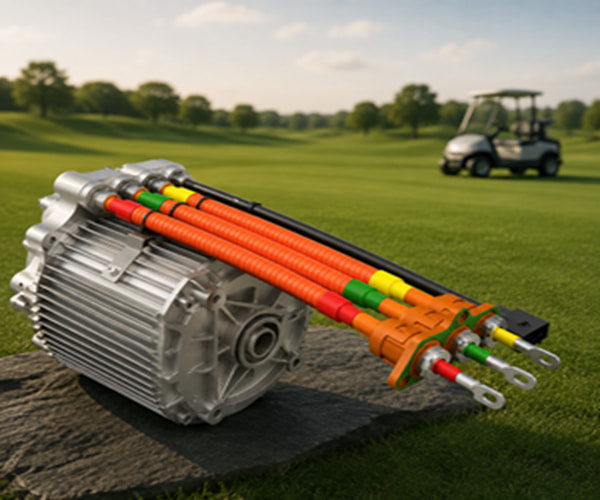
The above configuration is a reference plan for regular golf carts. Our company can provide customized designs such as power upgrade or parameter fine-tuning based on actual needs, ensuring a precise match between the motor and the overall vehicle operating conditions.
【If you would like to learn about the steep-slope 320-volt golf cart motor solution suitable for steeper slopes, or if you need guidance on choosing between different torque versions, please feel free to contact us. 】
4. Supplier Evaluation Checklist
- What are the temperature rise data of the motor during continuous climbing operation?
This is the most direct basis for evaluating whether the motor can adapt to hilly conditions. A qualified supplier should be able to provide temperature rise data under specific test conditions (slope, load, ambient temperature, duration), rather than just giving a conclusive description.
- Does the complete torque-speed characteristic curve get provided?
These characteristic curves can visually reflect the torque output capability of the motor over the entire speed range, and are the fundamental basis for judging the climbing power reserve. For high-torque electric golf cart motors, this curve can clearly show whether the motor has sufficient torque output capability in the low-speed climbing range.
- Has the protection level reached IP67?
IP67 is the mainstream standard for mountainous environments. When confirming whether the motor products provided by the supplier meet the IP67-rated club car motor standard, one should request the supplier to provide corresponding test records or certifications as support, rather than merely accepting the markings on the parameter table.
- Are there clear requirements for windward assembly?
The cooling effect of natural air-cooled motors is highly dependent on the vehicle installation conditions. The supplier should provide specific requirements such as the direction of the air duct, the windward area, and the avoidance distances of surrounding components. This is the key basis for the purchaser to determine whether the performance of the motor can be fully exerted after installation.
5. Pit Avoidance Guide: Common Mistakes in Motor Selection
- Misconception 1: The greater the peak torque, the better.
Peak torque is indeed the most crucial performance indicator for hilly terrains, but it is not necessarily the larger the better. The higher the torque, the greater the current required at the same voltage, and the more severe the heating of the windings will be. If the heat dissipation design cannot keep up, the advantages brought by the high torque will be quickly offset by overheating and reduced power.
The purchaser should match the torque according to the actual slope and load requirements, and leave an appropriate margin while ensuring it is sufficient.
- Misconception 2: Ignoring the rated power
Peak power determines "whether it can reach the top", while the rated power determines "how long it can maintain climbing without slowing down". Many purchasers tend to be impressed by the peak power, but they overlook whether the rated power meets the requirements for continuous climbing on hills.
The slopes of the hilly courses are usually not short slopes of just a few dozen meters, but long slopes that stretch for hundreds of meters. Under such conditions, the motor needs to continuously output power. Insufficient rated power will cause the speed to gradually slow down in the second half of the climbing process, and even stop halfway up the slope.
- Myth 3: Only relying on parameter markings for protection level
It only takes a few seconds to write "IP67" on the parameter table, but actually achieving this level requires a complete guarantee of the entire process including sealing structure design, process control, and factory inspection. Different suppliers have differences in their understanding and implementation standards of IP67.
It is suggested that when selecting the supplier, the specific waterproof and dustproof testing methods and standards should be requested from them, rather than merely accepting the markings on the parameter table. Disassembling and inspecting the sealing structure of the sample is also an effective way to verify the protection capability.
- Myth 4: Focusing only on the motor, ignoring the matching
The motor's own parameters meeting the standards is only the first step. The matching between the motor and the entire vehicle in terms of reduction ratio, tire diameter, load capacity, etc. is equally crucial. An excellent motor, if it is matched with an unreasonable reduction ratio, will still perform poorly when climbing slopes.
6.FAQ
Q1: Is the IP67 protection level really necessary?
A: Yes, it is. In hilly areas, there is a lot of rain and a lot of dust. The IP67 standard is the minimum requirement to ensure that the motor can operate stably and continuously in an environment with splashing water and mud.
Q2: Is natural air cooling sufficient?
A: It is sufficient for light load and short distances. However, for long climbs in hilly areas, it falls under a continuous high-load condition. We need to confirm whether the motor has adequate cooling design to prevent overheating and speed reduction.
Q3: How can we determine if the existing motor is suitable for hilly terrain?
A: Three indicators - whether the motor stops halfway during full-load climbing, whether the motor temperature is too high after climbing, and whether there are frequent failures during the rainy season.
7. Call to Action (CTA) for driving purchase conversions
If you are looking for a reliable 96V golf cart motors manufacturer, please feel free to contact us to obtain detailed product information and test data. At the same time, we can provide customized matching suggestions based on your specific vehicle parameters (such as reduction ratio, tire diameter, target load capacity, slope distribution on the golf course, etc.).
Click the link on the right to learn about the“ 96V golf cart electric drive solution”.