How does a igbt transistor improve the efficiency of a industrial inverter?
How IGBTs Boost Operational Efficiency
When we talk about power supply equipment, industrial frequency converters and other devices, their working efficiency is not just a simple technical figure on paper. In fact, efficiency determines your energy consumption cost, heat control management, and the long-term reliability of the entire system. As a supplier of power semiconductor components, we are often asked a question: How does the IGBT power module improve and enhance the operational efficiency of industrial inverters? The key lies in the fact that the IGBT module has the ability to handle high voltages and large currents, especially during actual operation.
Optimizing Switching to Reduce Losses
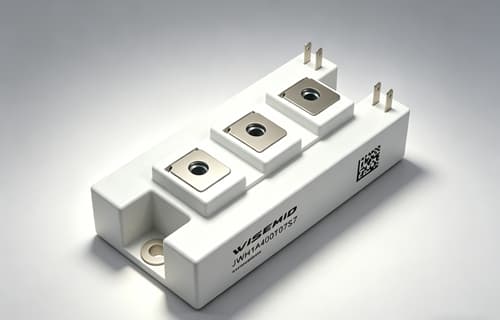
How can we understand this improvement? Let's take a typical example of an industrial inverter driving an AC motor as an illustration. The function of the inverter is to convert direct current into variable-frequency alternating current. During this process, the switching losses and conduction losses caused by the inverter are inevitable. And the IGBT, as the core switching device, can reduce these losses by lowering the saturation voltage and using faster switching edges. Our carefully designed gate drive board further optimizes the switching transition process, enabling the 400A IGBT for Industrial Inverter to help the equipment operate at the highest efficiency. An intuitive example is that in a motor controller operating at a 8 kHz switching frequency, the standard IGBT may emit 200 watts of heat, while the efficient IGBT can reduce this figure by 30%, thereby reducing the reliance on bulky heat sinks and active cooling functions.
Structural Optimization and Efficiency Advantages of High-Power 400A IGBT
Let's explore how a 400A IGBT can effectively enhance the performance of industrial systems. In many medium-power applications, the selection of a 650V 400A IGBT power transistor is a common choice. This is mainly because these devices achieve a good balance between their breakdown voltage and the current they can handle. When used in conjunction with a matching industrial IGBT inverter, the system can achieve more stable torque control, and you will also notice a reduction in overshoot.
More importantly, this trench gate IGBT power module etches vertical trenches on the silicon surface, creating narrower channels, thereby reducing the on-resistance. This design structure enables it to reduce the forward voltage by approximately 20% compared to the planar structure. The lower on-resistance not only allows the equipment to maintain a lower temperature under heavy loads, thereby directly increasing the overall efficiency by about 2%–3%, but also enables the inverter to output more power without upgrading the cooling system. This is a crucial performance improvement for industrial systems that need continuous operation.
Energy conservation and efficiency improvement in actual production
During the actual operation, the running time of equipment is equivalent to money. By selecting appropriate and efficient IGBT power modules (such as 400A 650V trench gate power modules), industrial inverters not only can reduce losses and improve efficiency, but also can lower additional energy expenditures. Moreover, they can operate the inverters at a higher switching frequency, reduce noise impact, and improve the working environment. For the purchaser or engineer, choosing IGBT is not only choosing a switching component, but also the key to enhancing industrial performance, reducing operating costs, and improving customer satisfaction.