
The core role of the motor controller in electric vehicles
For electric vehicles, the motor controller is a crucial component of the entire electric drive system, connecting the battery system, the motor, and the vehicle control system. It is responsible for managing the transmission process of electrical energy from the battery to the motor, converting the electrical energy efficiently and stably into the power required for vehicle operation.
During the actual operation of the vehicle, whether it is starting, accelerating, climbing, maintaining a constant speed, or decelerating and braking, the motor controller will adjust the current output and the motor response in real time according to different working conditions, ensuring that the vehicle maintains a smooth and efficient power performance.
For electric two-wheelers, the importance of electronic control is even more prominent. Due to the limited space and diverse application scenarios of two-wheelers, the controller not only needs to meet the power output requirements, but also needs to take into account energy consumption, handling experience, and long-term operational stability. A properly matched controller can fully utilize the motor performance, improve the vehicle's acceleration response capability, and help users obtain a more comfortable and safe riding experience.
Improving the overall performance of electric two-wheelers
As the electric two-wheeler market continues to grow, the demands for power systems among different types of vehicles are gradually becoming differentiated.
For example, electric scooters used for urban commuting focus more on range, operational stability, and a comfortable driving experience; while high-speed electric motorcycles require stronger power response, higher current carrying capacity, and better heat dissipation performance.
Therefore, the motor controller is not merely responsible for providing power output; it needs to be precisely matched with the motor, battery, and overall vehicle application requirements. If the controller's power is insufficient, the vehicle may encounter power shortage issues during acceleration, climbing, or high-speed operation; if the control strategy does not match the motor performance, it will also affect the vehicle's efficiency and driving experience.
Choosing a reasonable controller can help the vehicle achieve the optimal balance of power performance, energy utilization efficiency, and system reliability.
Choose the appropriate controller based on different applications
For electric two-wheelers, different speed levels and power requirements correspond to different electronic control configurations. For high-speed electric two-wheelers with speeds ranging from 60-80 feet per minute and 100-120 feet per minute, there are different requirements for the voltage, current output capacity, and control accuracy of the controller. It is necessary to select a matching electronic control solution based on the vehicle performance positioning.
For electric two-wheelers with a speed range of around 60-80 feet per minute, the controller needs to have stable power output capability and efficient energy management capability to meet the application requirements such as urban commuting, daily travel, and short to medium-distance transportation.
In practical applications, for 60-80 feet per minute electric two-wheelers, the controller can choose an adapter with a voltage range of 48V-72V or 48V-96V according to the motor power and battery system requirements to meet the power performance and range needs of different vehicle models.
For high-speed electric motorcycles with a speed of 100-120 feet per minute, the vehicle has higher requirements for power output, control accuracy, and system stability. Such vehicles are usually used for long-distance travel and high-performance riding scenarios, and require the controller to have stronger current handling capacity and continuous operation capability.
For high-speed electric two-wheelers with a speed of 100-120 feet per minute, it is usually necessary to select a high-performance controller with a voltage range of 48V-72V based on the motor power, battery capacity, and overall load conditions to achieve a balance between power performance, efficiency, and reliability.
Two-wheel vehicle electric control solution
Different types of electric vehicles have significant differences in technical requirements for controllers. Urban commuting electric bikes, high-speed electric motorcycles, and electric tricycles have distinct characteristics in terms of power demand, communication methods, heat dissipation design, and control strategies.
Therefore, for different vehicle application scenarios, we have developed a three-category dedicated motor controller product matrix. Relying on the mature 48V-based motor controller design, medium-power electric vehicles can achieve the optimal balance between voltage adaptation, power performance, and system efficiency. This provides stable and standardized electronic control bases for different models, and through precise scene-specific motor controller type selection logic, deeply adapt to the needs of all scenarios for two-wheel vehicle travel, optimize the coordination efficiency of controllers, motors, batteries, and the entire vehicle system, and help automakers create highly adaptable and highly reliable electric products.
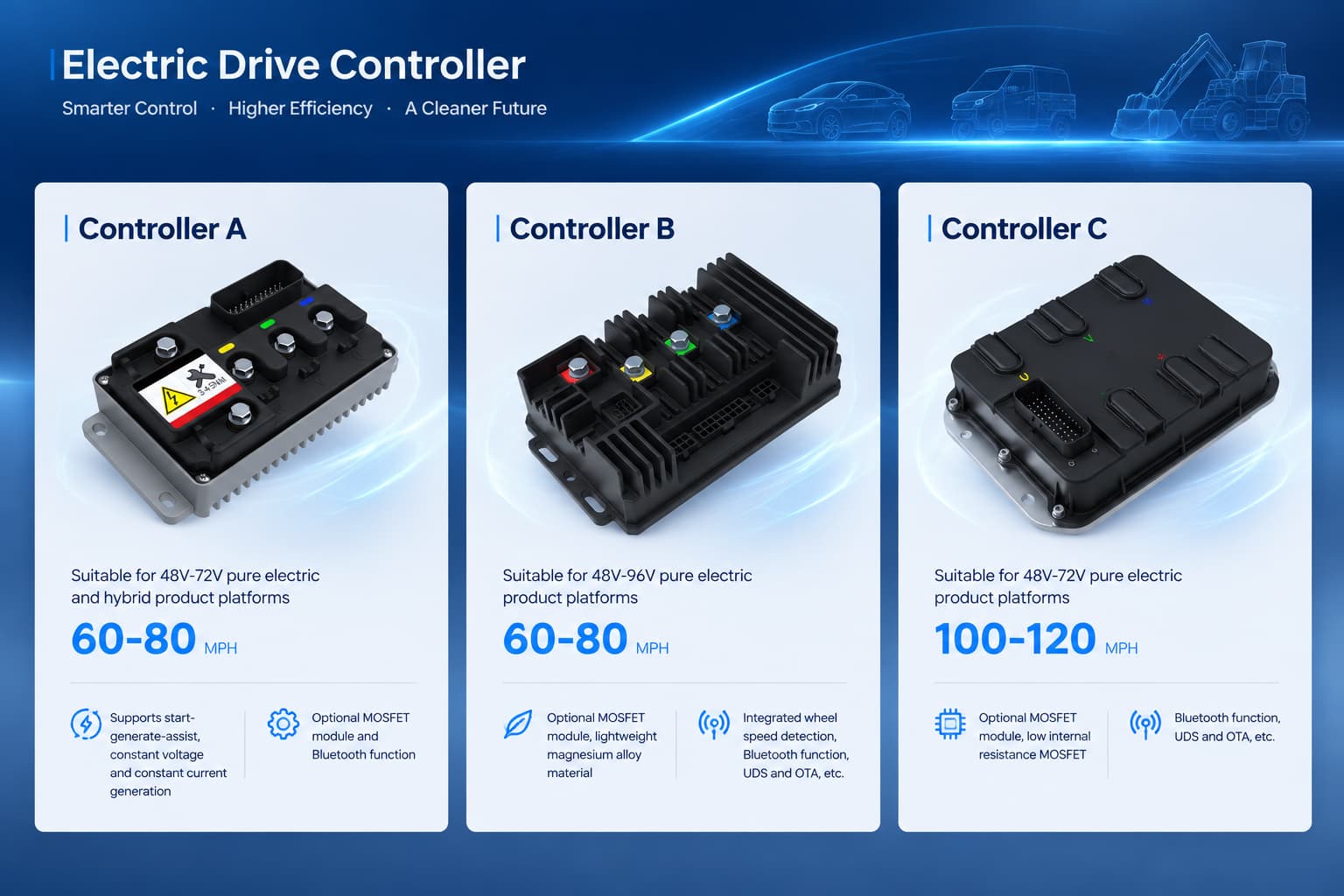
The 60-80 km electric two-wheelers are mainly used for urban commuting, daily transportation and short to medium distance travel. The core requirements are stable power output and efficient energy management. The adaptability and cost performance of the electronic control system are also highly demanded. For this scenario, we have developed two dedicated electronic control products. They can be selected flexibly based on the motor power of the entire vehicle and the battery configuration, precisely matching the regular and mid-to-high-end 60-80 km models, optimizing the coordination efficiency of the three power systems of the entire vehicle, and balancing the power performance and range.
| Product Type | Core Configuration Parameters | Features | Application Scenarios |
| 48V – 72VPure Electric & Hybrid ECU Products | Rated Voltage: 48 / 60 / 72 Vdc | Supports Start-Generation-Power Assist | Two-WheelerSpeed: 60 – 80 km/h |
| Optional MOSFET Module | |||
| Sensor: Hall + Magnetic Encoder | Bluetooth Function | ||
| 48V – 96VPure Electric ECU Products | Rated Voltage: 48 / 60 / 72 Vdc | Magnesium Alloy Lightweight Material | Two-Wheeler / Three-WheelerSpeed: 60 – 80 km/h |
| Optional MOSFET Module | |||
| Sensor: Hall + Magnetic Encoder | Integrated Wheel Speed Detection, Bluetooth Function, UDS and OTA |
The 100-120 cm high-speed electric motorcycles are mainly used for long-distance travel and high-performance riding scenarios. They have extremely high requirements for the power output, control accuracy, load capacity and operational stability of the electronic control system. For this high-speed model, we have specially developed high-performance electronic control products, which can perfectly meet the running needs of high-load, high-speed operation of high-speed electric motorcycles, achieving the ultimate balance of vehicle power, efficiency and reliability. The core information of the product is as follows:
| Product Type | Core Configuration Parameters | Features | Application Scenarios |
| 48V–72VPure Electric ECU Products | Rated Voltage: 48/60/72 Vdc | Optional MOSFET Module | Electric MotorcycleSpeed: 100–120 km/h |
| Rated / Peak Phase Current: 160A / 350A | Low Internal Resistance MOSFET | ||
| Sensor: Magnetic Encoder | Bluetooth Function, UDS, OTA, etc. |
Intelligent control technology drives the development of electric mobility
With the continuous growth of global electric transportation, motor controllers are upgrading from traditional power control components to intelligent and high-efficiency control systems.
Modern electronic control technology not only focuses on power output, but also integrates intelligent communication, OTA upgrades, wheel speed detection, and more precise energy management functions, enabling electric vehicles to achieve higher efficiency, greater stability, and more intelligent operation experiences.
For customers who need to develop high-performance electric vehicles, choosing a controller supplier with technical research and development capabilities and product experience is very important. The high-performance AC motor controller for electric vehicles can provide more stable power control capabilities for electric vehicles and support the development needs of future electric transportation products.
As a professional motor controller supplier, WISE focuses on the research and development and manufacturing of electric drive products in electric two-wheelers, electric three-wheelers, and other electric transportation applications. Through continuous optimization of control technology and product design, we provide reliable and efficient motor controller solutions for global customers, helping the electric transportation industry continue to develop.