As the process of electrification continues to accelerate, more and more vehicle manufacturers are paying attention to the efficiency, reliability and overall performance of the electric drive systems. Of course, this also includes construction machinery vehicles. Compared with passenger cars, construction machinery usually faces more complex operating environments: high-load operation, frequent starts and stops, long-term continuous operation, and harsh working conditions, etc. Therefore, choosing the appropriate motor products is of great significance for improving the performance of construction machinery, reducing operating costs and extending service life.
In the current development of electric drive technology, flat-wound motors and round-wound motors are the two most common motor solutions. There are certain differences between the two in terms of efficiency, power density, heat dissipation performance and application scenarios. To help vehicle manufacturers and industrial manufacturers achieve the optimal performance of construction machinery, it is necessary to conduct a comprehensive evaluation of the two motor solutions based on actual project requirements and understanding of the characteristics of different motor technologies, and select a more suitable power solution.

Selecting suitable motor technology for construction machinery
The trend of electrification has also sparked a wave in the construction machinery sector, which is the inevitable path for the future of construction machinery. For construction machinery, the motor is the core of power, replacing the traditional internal combustion engine and responsible for outputting torque and driving the entire machine as well as various execution units. It can be said without exaggeration that the motor is equivalent to the "heart" of construction machinery. The majority of the power sources for the operations of construction machinery rely on the motor for supply.
For electric construction machinery, the motor is not only the core of power output but also directly affects the overall efficiency, reliability, and the user experience of the driver. The selection of the motor needs to comprehensively consider factors such as rated voltage, peak torque, working cycle, installation space, and actual operating environment. These all impose strict specific technical requirements on the motor: Construction machinery motors must have high torque overload capacity, output stability, continuous working efficiency, reliable heat dissipation performance, and high-strength structural adaptability. At the same time, they need to take into account the lightweighting of the entire machine and the compatibility of the vehicle space.
In contrast, ordinary motors on the market are limited by the winding structure and heat dissipation design. They have insufficient torque and heat dissipation, cannot maintain high efficiency operation for a long time, and are prone to power deficiency and failure to reach the specified service life.
Therefore, currently, most of the market adopts advanced winding technology for permanent magnet synchronous motor solutions. With advanced electromagnetic design and winding processes, they have become the core choice for construction machinery, special vehicles, and off-road vehicles.
After determining to adopt the permanent magnet synchronous motor route, further selection of the stator winding scheme is required. Currently, permanent magnet synchronous motors are mainly divided into two technical routes: round wire winding and flat wire winding. These two winding structures have different advantages and disadvantages in terms of power density, heat dissipation capacity, performance under continuous operation, and project development costs. Different construction machinery projects may have different suitable winding schemes.
Many manufacturers of construction machinery, during the selection stage of traction motors, will weigh between the flat wire and round wire schemes.
Flat-wire winding: Efficient and compact, suitable for heavy-duty conditions
The flat-wire motor (Hairpin Motor) uses rectangular copper conductors instead of traditional circular copper wire windings. By optimizing the utilization of stator slot space, it increases the copper filling rate, thereby reducing resistance loss and enhancing the motor's heat dissipation capacity.
For applications in construction machinery, these advantages can directly improve the vehicle's performance. Leveraging the high slot filling rate advantage, the flat-wire motor has more uniform heat dissipation and higher efficiency. It is less prone to thermal degradation during long-term heavy-load operation and can continuously and stably output power. At the same time, the flat-wire structure has higher power density, enabling greater power output in a smaller volume, perfectly addressing the challenges of limited installation space and limited electrical capacity in construction machinery.
Compared to traditional circular wire winding designs, the flat-wire motor can achieve higher power output in a more compact structure, meeting the demands for lightweighting and space optimization of vehicles. This is particularly important for electric construction machinery projects with limited battery capacity and installation space. The compact flat-wire electric drive structure can ensure unchanged vehicle power performance, optimize the vehicle layout, and provide more space for lightweighting and structural integration design.
Round wire winding: Entry-level solution, suitable for basic conditions
The round wire winding has a simple structure and low development threshold, capable of meeting the basic power requirements of medium-power equipment and is suitable for projects with limited budgets. However, due to its mature manufacturing process and low production cost, it is still widely used in the fields of new energy vehicles and industrial equipment.
Nevertheless, compared with flat wire motors, round wire motors have certain limitations in copper utilization, heat dissipation capacity, and power density. When vehicles have higher requirements for output performance, space utilization, and operating efficiency, flat wire technology can provide a better solution.
Therefore, in the actual project development process, there is no absolutely superior or inferior motor type. The key lies in choosing the most suitable technical solution based on the vehicle application scenario.
| Comparison Item | Hairpin Motor | Round Wire Motor |
| Winding Structure | Rectangular copper winding | Round copper winding |
| Power Density | Higher | Standard |
| Heat Dissipation Performance | Excellent | Good |
| Efficiency Performance | High-efficiency operation | Meets basic requirements |
| Space Utilization | More compact | Relatively low |
Based on actual needs, conduct selection matching
In the electric drive project of construction machinery, when choosing the motor, it is necessary to fully consider the actual application scenarios and working conditions, rather than merely pursuing a certain technological trend.
For equipment that requires long-term operation and heavy-load operations, there are high requirements for motor heat dissipation, continuous torque and reliability. Flat-wound PMSM is more suitable for such scenarios. Low-voltage compact equipment also requires coordinated optimization of the motor, electrical control and the entire vehicle system.
It is recommended that the vehicle manufacturer cooperate with a professional construction machinery-compatible motor factory to obtain a customized motor solution, including structural optimization, performance matching and system integration.
Customized electric drive solutions, enhancing vehicle performance
The electrification of construction machinery and commercial vehicles is continuously advancing, and customers' demands for motor suppliers have shifted from simple product procurement to the development of complete electric drive solutions.
Professional electric motor manufacturers for commercial vehicles not only provide motor products but also can carry out customized development based on vehicle requirements, including motor selection, electrical control matching, performance optimization, and application support, helping customers shorten the research and development cycle and enhance product competitiveness.
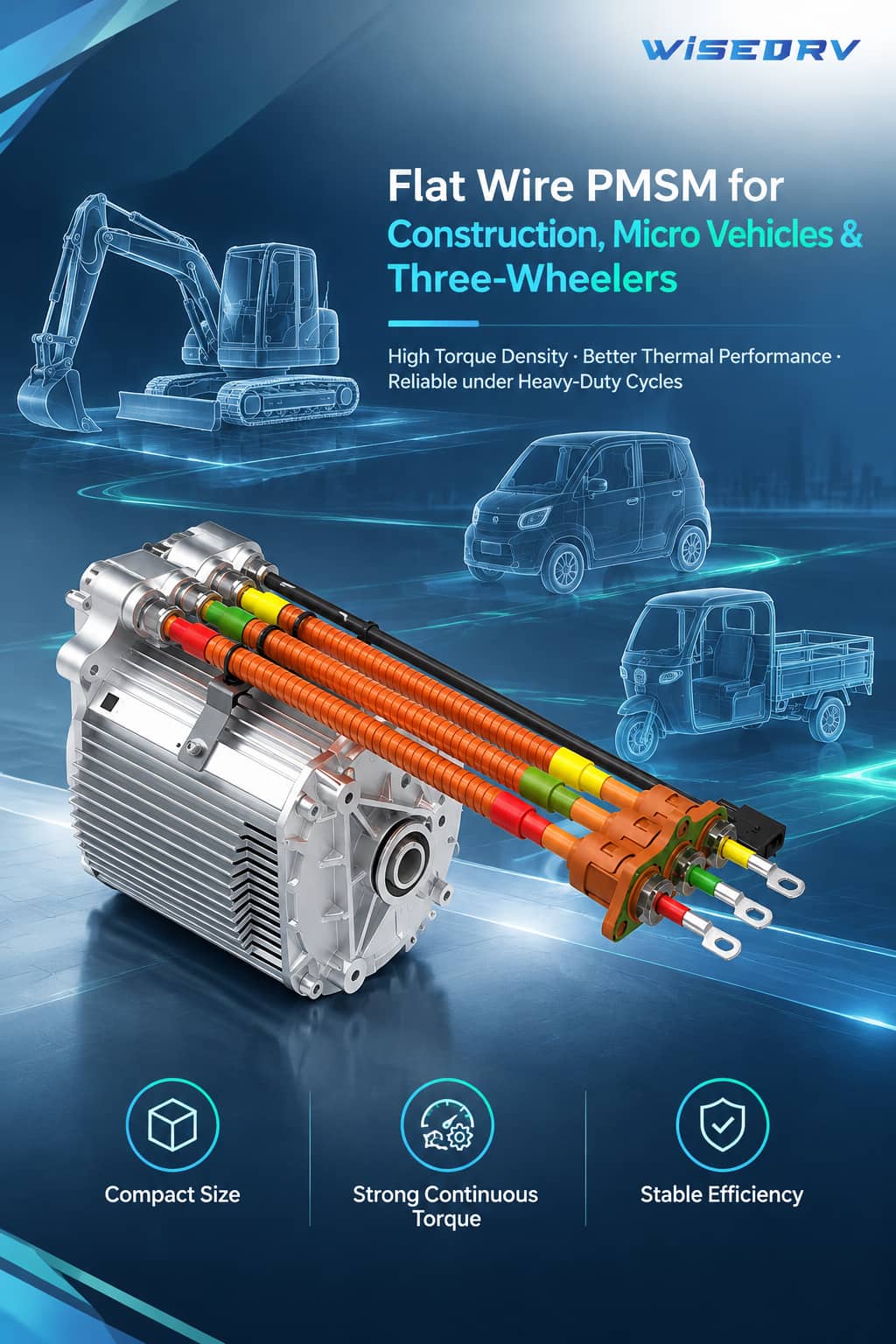
WISE has developed 96V hairpin winding pmsm, and at the same time achieved electrical control matching. This enables construction machinery to achieve a good balance between power output, system efficiency, and structural compactness.
With advanced flat-wire winding technology, this type of motor can meet the requirements of lightweight design, high reliability operation, and low energy consumption, and is suitable for construction machinery, commercial vehicles, and other new energy equipment fields.
Building an efficient and reliable future electric drive system
The flat-wound motor and the round-wound motor each have their own advantages. The final choice needs to be made by comprehensively considering the vehicle application scenarios, performance targets, operating environment, and long-term reliability requirements.
WISE is committed to combining advanced motor technology with customized engineering capabilities to develop more efficient, reliable, and market-competitive electric drive systems for vehicle manufacturers. It provides continuous power support for the next generation of electric construction machinery and commercial vehicles.
If you are looking for high-performance motors or electric drive solutions suitable for construction machinery or commercial vehicle projects, please click the image on the right to learn about our product details and technical parameters, or contact our engineering team via the official email to obtain customized electric drive solutions and technical support.