Electric two-wheelers, electric motorcycles, and micro vehicles account for a high proportion of electric transportation vehicles. As the popularity of electric transportation expands, the demand for these types of vehicles is gradually increasing. Electronic control, as an important component of the entire vehicle, also experiences a significant increase in demand. For purchasing personnel who purchase medium-power electronic control units, how to achieve a balance among performance, reliability, and cost has become a real challenge.
Users want stronger acceleration, longer range, and lower prices; vehicle manufacturers want lighter controllers and fewer after-sales repairs. However, the reality is: higher power density means more expensive components, thicker heat dissipation margin means higher costs, and the more you squeeze costs, the reliability of the product will be sacrificed.
However, balance does not mean compromise. During the research and production of motor controllers, I sorted out and derived a clear logic: true balance comes from the precise definition of "performance", the hierarchical design of "reliability", and the structural decomposition of "cost".
Selection Logic Based On Actual Working Conditions
For this type of medium power e mobility controller selection, it must be based on the actual working conditions of the vehicle. Only vehicles that match the real needs with product parameter specifications can achieve maximum value.
Many vehicle manufacturers, in order to avoid risks, habitually directly purchase the highest specification controllers, which will lead to unnecessary cost waste and performance redundancy. Mature suppliers will divide standard versions and customized product lines, adjust protection logic and communication interfaces flexibly according to vehicle weight, maximum speed, and usage scenarios, and control costs while meeting the working condition requirements. A highly adaptable controller is not necessarily the one with the highest parameters, but its capability boundary just matches the vehicle's performance.
Simplifying On-Site Debugging And Fault Diagnosis
To further reduce after-sales maintenance costs, facilitate the production line debugging of vehicle manufacturers and on-site operations of the after-sales maintenance team, the can bluetooth ac motor controller has extremely high practical value. The CAN bus ensures stable and real-time communication within the power system, and the built-in Bluetooth eliminates the need for expensive dedicated debugging adapters. Technicians can directly complete parameter configuration, firmware flashing, and fault reading using mobile devices.
This type of electronic control solution can significantly improve the calibration speed of the production line and the efficiency of on-site maintenance, helping vehicle customers and fleet operators reduce the total lifecycle usage costs. While reducing the later maintenance costs, it also enhances the reliability of the product during long-term use.
Customized Services Based On The Platform
Facing vehicles with different specifications and parameters on the market, customized services are particularly important. Generalized equipment is difficult to cover all requirements, and developing a complete power system from scratch, the cost and project effort required are beyond the scope of many enterprises' affordability.
Cooperating with customizable motor controller manufacturers is one of the most efficient ways to balance performance, reliability, and cost. Customization does not mean redeveloping the entire hardware platform from scratch. Experienced manufacturers based on mature core hardware that has been fully verified and successfully implemented, only make minor adjustments to the torque algorithm, current-limiting curves, protection strategies, and peripheral interfaces for the customer's project. Reusing the reliability-verified platform can save a lot of repetitive durability tests, shorten the development cycle, and control the cost of individual products. Whether the customer only needs software fine-tuning or modifies a few hardware interfaces, platform-based customization can avoid the high R&D investment costs brought by new development.
Wise's 72V 400A Controller Example
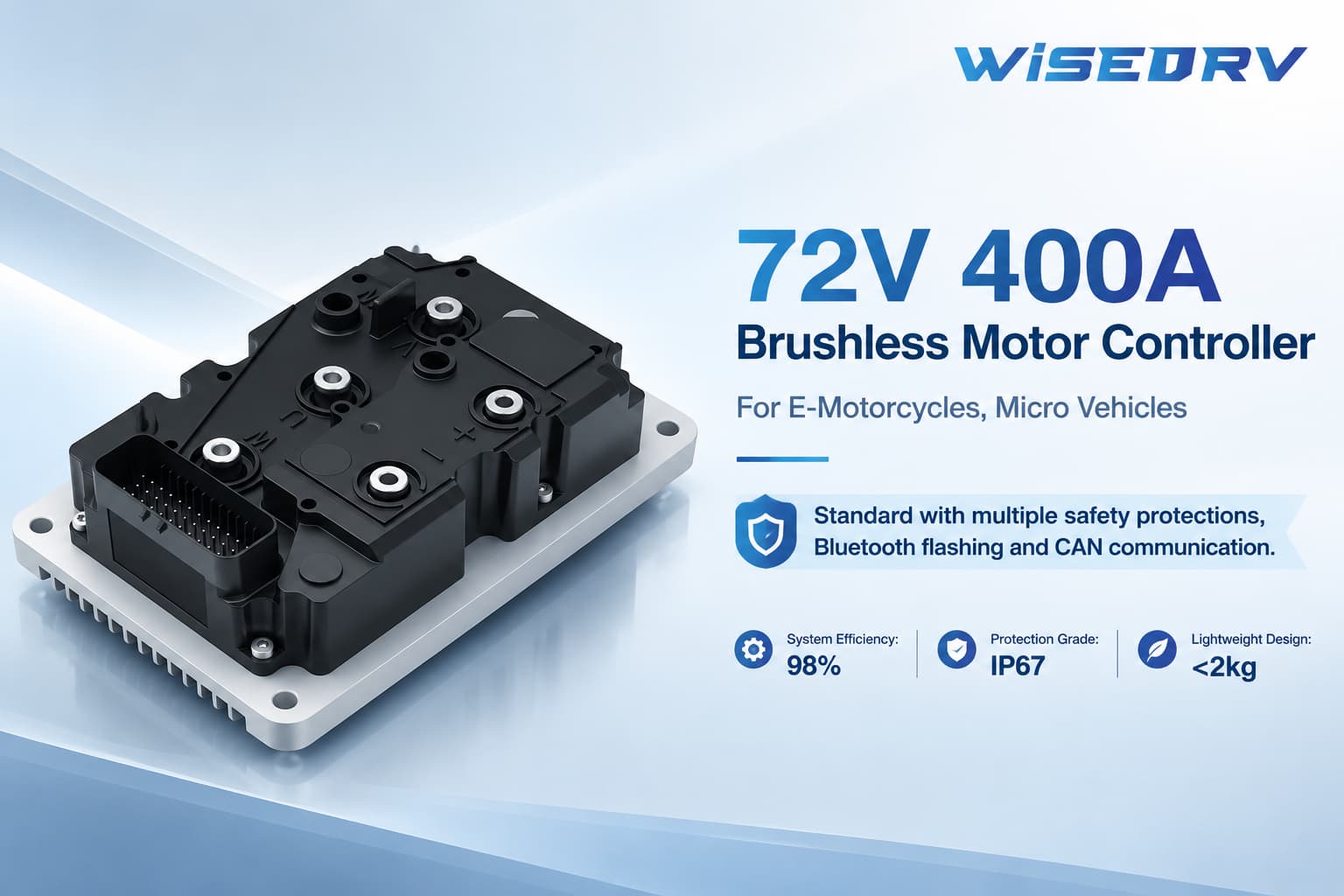
The selection logic and platform customization services mentioned earlier can achieve a balance among product performance, reliability, and cost. But what happens in specific cases? Is it based on idealized reasoning or can it be truly implemented? The following product example will tell you the answer:
Under this selection and development logic, WISE's 72V 400A Brushless Motor Controller is precisely a solution tailored for medium and large power electric motorcycles and micro vehicles.
[Product Introduction]
- Application scenarios: Medium and large power electric motorcycles, micro vehicles
- Electrical specifications: Rated 72Vdc, operating voltage 60–84Vdc; peak current 400A, peak power 10kW
- Control scheme: Torque loop control, supports ABZ / HALL dual-position sensors
- Efficiency and heat dissipation: Maximum system efficiency 98%, natural air cooling, simple and easy to maintain layout
- Protection and reliability: IP67 protection level, suitable for outdoor complex conditions; equipped with KTY84 temperature sensor, adjustable temperature protection threshold, standard overcurrent, overvoltage, and overheat multiple safety protections
- Debugging communication: CAN2.0B communication protocol, compatible with vehicle-mounted equipment; comes with built-in Bluetooth, supporting parameter programming, debugging, and fault diagnosis
- Structural advantages: Overall weight < 2kg, compact structure, saves vehicle installation space
This electric control does not blindly pile up redundant performance. The product performance is designed around the real needs of heavy-duty climbing and long-term outdoor operation, perfectly matching the comprehensive requirements of such travel vehicles for power, stability, and convenient operation and maintenance.
Making Decisions Based On The Full Life Cycle Value
We believe that the power platform procurement personnel of automotive manufacturers will have their own thoughts or gains after reading this article.
The core of seeking the balance among the three lies in establishing a full life cycle thinking. For a high-quality medium and large power controller, the evaluation criteria should not only focus on peak power parameters. It needs to output stable and controllable torque under continuous load, be able to withstand the long-term harsh outdoor environment tests, and be suitable for mass production while having core competitiveness of the product. When vehicle customers choose power solutions, they should prioritize matching the working conditions, reserve reasonable protection margins, and consider the convenience of debugging and maintenance, so as to truly achieve the goals of being reliable to use, having controllable faults, and having controllable costs.
If you are doing controller selection for electric two-wheeled vehicle models or want to further understand the adaptability of our 72V 400A brushless motor controller in your working conditions, you can click on the category of medium and large power motor controllers for electric two-wheelers to view the detailed product parameters and specifications. You can also click the "Contact Us" interface to send your requirements to us, and WISE's technical team will help you with a targeted selection matching.